
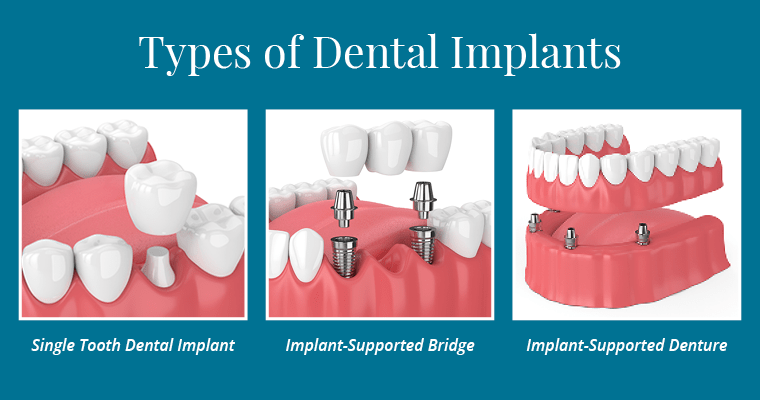
If you have ever thought of visiting a Dentist Surprise for a more relaxed experience during your dental procedures, you might already know that modern dentistry presents a variety of methods to assist tooth restoration or replacements. Dental implants are the most sought-after method of treatment for missing teeth. They resemble natural teeth in function and appearance while also fortifying your jawbone. Nevertheless, with the available types of implants, you might be confused about which will best meet your requirements. Figuring out the various implant types, the materials used, and the steps involved in the process can help you make an educated choice. This article goes deep into dental implants, giving you all the information you need so that you can be sure of your oral health options.
Dental implants are an increasingly popular treatment option for several reasons. First, they provide a solid foundation resembling the function of a natural tooth root that prevents the jaw from bone loss over time. Secondly, they are amongst those that do not link support to neighboring teeth, unlike some traditional bridges, assisting in the preservation of adjacent teeth. They also give an aesthetic result thus they often harmonize with existing teeth. Despite the numerous advantages that dental implants offer, the dentist also identifies which type is most suitable based on several factors such as the density of jawbone, the health of gums, and medical records of the patients.
A person’s ability to get dental implants is often determined by the location of missing teeth, availability of bone, and their health profile. Normally all dental patients are eligible to be candidates for dental implants; however, smokers, people with chronic diseases such as diabetes, and inadequate bone patients may need to go through specialized procedures or modifications. Though a surgical process is needed, the success rate of dental implants is observed to be particularly in skilled hands practitioners. It is worth mentioning that the whole process can take several months, with healing time being crucial for the implant to fuse with the bone. After the operation is done, a lot of people say that they feel a new degree of confidence in such activities as eating, speaking, or smiling, as a result of the newly acquired implants.
The two main classifications of implants are examined below. In the first part, we will focus on the Types of Dental Implants, which are categorized based on different methods of placement and fixation in the oral cavity. Secondly, we will explore the Different Types of Dental Implants in terms of the operational or structural approach, each of which has its own particular advantages for certain dental conditions.
Types of Dental Implants
When discussing the types of dental implants, the focus is usually on where the implant is positioned relative to the jawbone and gum tissue. Two primary categories exist: endosteal and subperiosteal implants.
- Endosteal Implants: The most advanced kind among which, where the jawbone is directly involved to support the implants, together with the most titanium prosthetics, are the components practically without any defects. Generally speaking, they are made of titanium and oligomeric metals and the implant is a titanium screw or cylinder which is used to fix the jawbone. The first step of the procedure is to insert the implant into the bone, and then a healing period is required for the osseointegration process which allows the implant to fuse with the surrounding bone tissue. After this period, an abutment is attached to the implant, and finally, the artificial tooth (crown) is secured on top. Endosteal implants generally suit individuals with adequate bone density, making them an excellent, long-term solution for replacing single or multiple teeth.
- Subperiosteal Implants: Compared to endosteal implants that are placed in the jaw bone, the subperiosteal implants stand on top of the bone and under the gum tissue. After a metal framework is placed on the jaw, the gums heal, it holds the frame in place. The attached posts penetrate the gums, and the prosthetic teeth are then mounted on these posts. Patients who did not have enough bone height were once treated with subperiosteal implants. However, with better grafting treatment options and endosteal implants, which are currently in fashion, subperiosteal implants are less required. Nevertheless, they are still usually used in cases where reshaping the bone is not possible or when the patient’s bone mass is inadequate for the exact models of implants.
Regardless of the type of thing, proper caring is most important. Complying with good oral hygiene including regular dental checks and periodontal appointments at the dentist, the success of your implant is assured. I can say that most of the implants can last many years or a lifetime, provided they are well maintained. But gum diseases or bad habits like smoking will contribute to the failure of the implant. Hence, the long-term success of the implant is reliant on both the surgery and the patient’s acceptance of evident oral hygiene.
Different Types of Dental Implants
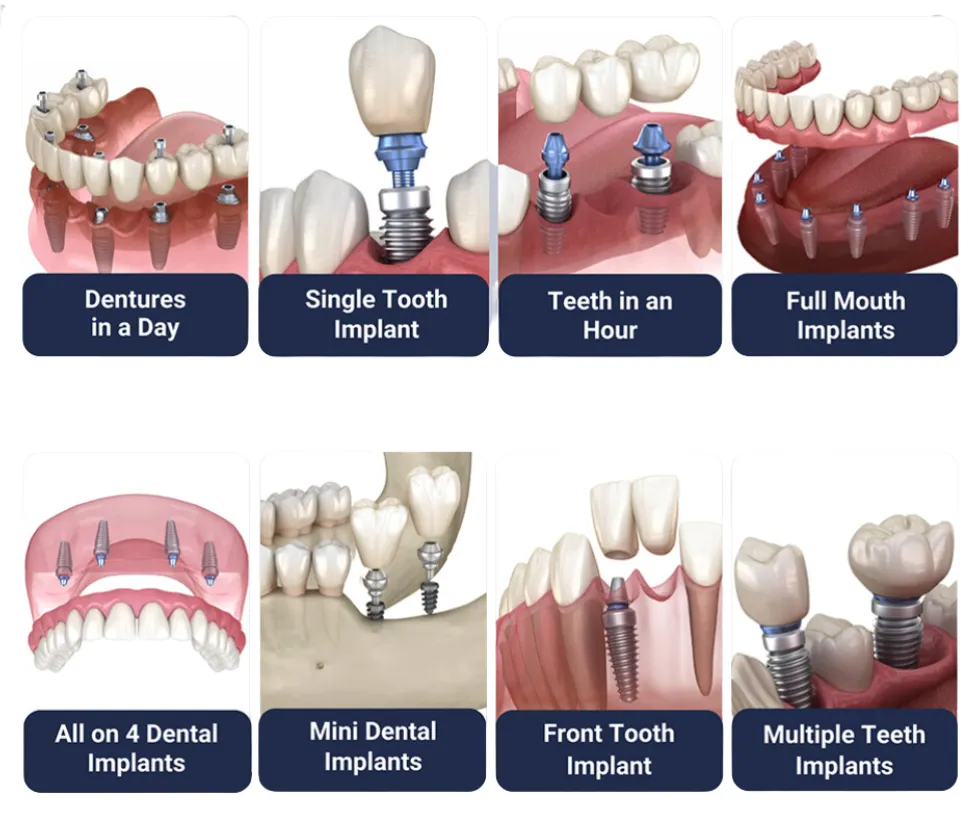
In addition to classifying them according to their position (endosteal vs. subperiosteal), we can also distinguish dental implants based on their dimension and the processing technique. Realizing these distinctions will enable you to engage your dentist in a better way, enabling the method that will best suit your situation.
- Standard vs. Mini Implants
Standard Implants: Most of the time, standard implants are used, which commonly have a larger diameter. They are sufficiently powerful to be robust and provide essential support for the prosthetic tooth. A multi-step surgery is an integrated part of these implants, meaning the process will first begin with placing the implant, healing time will be allowed, and then the abutment and crown will be put on.
Mini Implants: Mini implants are considerably smaller in most of the cases, so they can even be positioned in such regions of limited bone density. Their placement is quite practical and often only a single session is needed for them to be done. Though mini implants might not provide the same stability level as regular implants, particularly in the case of being placed in a greater bite pressure area, their usage is often prescribed due to the lower risk involved.
- Immediate Load Implants
Also called “same-day implants,” immediate load implants are the implants followed by the crowns on the same day of surgery. The immediate loading implants are comfortable for patients because they do not have to go through a waiting period for a single tooth which is otherwise needed. However, to guarantee immediate success, patients must have proper implants that have enough bone density, accurate placement, and bite force that is kept to a minimum during the healing period. - All-on-4 or All-on-6 Implants
These systems provide a means for patients who have lost many or all of their teeth in one arch (upper or lower jaw) to receive prosthetic teeth. The four or six implants are placed in a way that they make maximum contact with the bone, even the case of limited bone volume, by angling the implants. Then, a complete arch of replacement teeth is attached to these implants. This approach may be more cost-effective than placing individual implants for every missing tooth and often takes fewer sessions. It is particularly helpful for individuals who have lost many teeth to achieve the long-term stability of the tooth without the need for multiple surgeries. - Zygomatic Implants
Patients who are at the rock bottom and do not desire or cannot have a lot of grafting surgery on their upper jaw qualify for a zygomatic implant. Unlike the regular use of grafting surgery and traditional implants, these implants are only introduced to the cheekbone (zygomatic bone) and nothing. Though this method gives better results than autogenous bone with asymptomatic injury, experienced professionals should first undergo extensive training and continue their education regularly. Thus, these procedures should be restricted to clinics with proper facilities and specialists. They could be the only hope of getting out of the implant cycle of failure that other techniques would have caused.
Although every single kind of tooth implant has its owns perks, the ultimate deciding factor lies within you depending on the said individual circumstances you find yourself in. The precondition is that all the elements such as bone health, budgetary considerations, service time, and overall health must be evaluated. Your dentist will frequently suggest the simplest, most reliable approach to treatment that can ensure a long-lasting outcome.
Conclusion
Dental implants have paved a way for many individuals who are faced with tooth loss. These innovative solutions improve comfort, functionality, as well as self-esteem. It is essential to understand that the choice of a dental implant type out of different options will come from a thorough consultation and a comprehensive evaluation of your oral health. If you are looking for a replacement for one tooth or a full-arch restoration, when you know the basics of how each type of implant works to integrate with your dental team you will be in a position where you can make a trusted decision.
It is critical to enter the first step of the implant treatment journey with a proper enlightenment of what this condition is going to entail and a sincere dedication to after care as the two most important factors. Practicing good oral hygiene, being on time for the follow-ups, and treating other existing health conditions if any, are things that could lead to success. Continuous innovation in dental technology has made procedures safer and more available gradually. If you research appropriately and have effective collaboration with a qualified dentist, you can find the best implant option to have a perfect smile as well as self-confidence.